Claude Sonnet 4.5 retires on 30 November: find it in your code
November 14, 2026 · Updated November 14, 2026
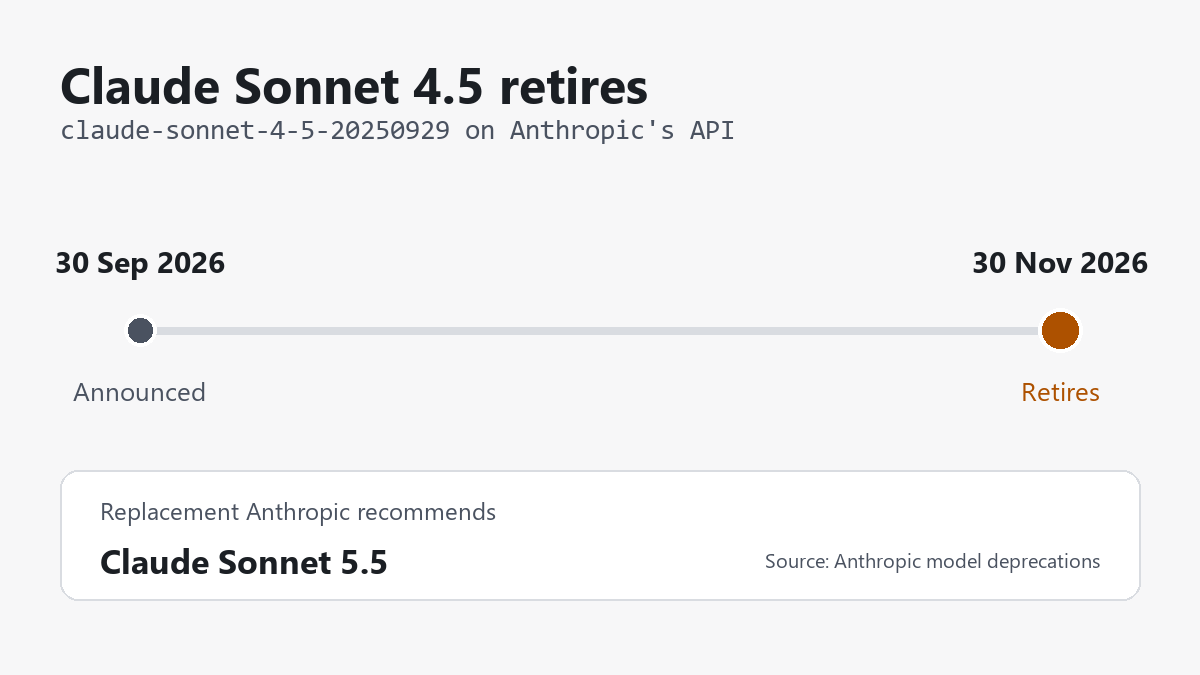
Anthropic retires Claude Sonnet 4.5 on 30 November 2026. After that, requests to claude-sonnet-4-5-20250929 on Anthropic's API fail. Anthropic recommends moving to Claude Sonnet 5.5. (Anthropic's notice, checked 14 November 2026.)
Where the ID hides
The ID rarely sits in one place. Check:
- application code and SDK calls;
- environment defaults and
.env.examplefiles; - infrastructure code (Terraform variables, Helm values);
- notebooks and eval scripts;
- fallback paths that only run when something else fails.
The free method
rg -n "claude-sonnet-4-5" --hidden -g '!node_modules'It misses IDs built from parts (f"claude-sonnet-{ver}") and aliases, so read the hits around config loaders too.
Using Bedrock or Google Cloud?
Those platforms set their own retirement dates, which can differ from Anthropic's. Check your platform's page. See why your Bedrock Claude may retire on a different date.
Before you switch
- Run your own evaluation set on Claude Sonnet 5.5 and compare the outputs before you change production.
- Check the request parameters you send. Some newer Claude models reject sampling parameters; see temperature, top_p and top_k on newer Claude models.
- Remove the old ID from fallbacks and retry paths too, not just the main call.
- Keep the model ID in one config value, so the next retirement is a one-line change: keep AI model IDs in one place.
The 60-day retirement runbook has the full checklist.
With SunsetLint
Install the GitHub App and it opens one issue per repository listing each match with file, line, the retirement date, the replacement and the source. On Pro, pull requests also get a check with line notes. It never blocks a merge and never changes your code. Free for public repositories and your first 3 private ones.